Category: HR Unfiltered Blog
-
What Breaks Alignment: Capacity, Incentives, and Structural Misalignment
TL;DR Alignment doesn’t fail because people lack intent, it fails because the organizational system doesn’t support consistent decision-making and prioritization. Four common structural forces break alignment: limited capacity, misaligned incentives, unclear decision rights, and poor role structures. These breakdowns create execution gaps that persist even when communication feels “clear.” Leaders who diagnose and adjust these…
-

Alignment as an Operating System: Why Execution Requires More Than Communication
TL;DR Most organizations think alignment is about communication or shared understanding in meetings. In reality, alignment is a repeatable operating system that governs how strategy becomes daily execution. Without systems (not just words) execution stalls because decisions, priorities, accountability, and behaviors aren’t consistently structured. Leaders who embed alignment into how work actually happens unlock predictability,…
-
The Illusion of Clarity:
Why Leaders Think They’re Clear and What That Really Costs Your Business TL;DR Most business leaders believe they’ve communicated priorities clearly. In reality, teams interpret goals differently, make conflicting decisions, and execute based on assumptions. This “illusion of clarity” is one of the biggest hidden causes of execution failure in small businesses. When clarity exists…
-
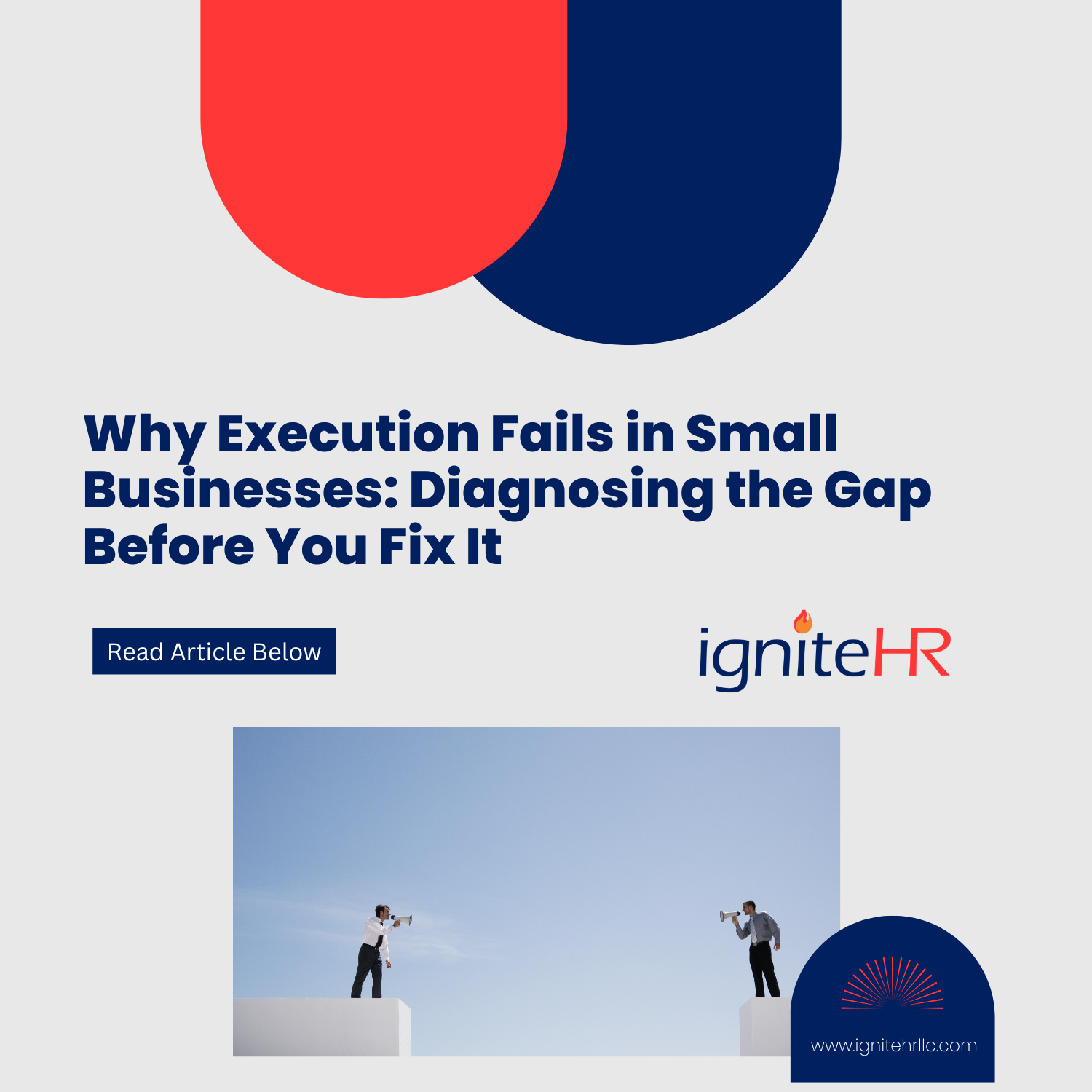
Why Execution Fails in Small Businesses: Diagnosing the Gap Before You Fix It
TL;DR Most small businesses don’t struggle because they lack strategy. They fail to translate strategy into consistent execution. The gap between planning and performance shows up as unclear priorities, resource friction, and teams that run in different directions. Business owners can diagnose this execution gap by identifying where priorities are unclear, decisions stall, and daily…
-
Between the Years: 7 HR Moves Smart SMB Leaders Make Before January
TL;DR The final week of the year is a strategic reset, not a break. Use it to: • Validate payroll and year-end tax readiness • Review benefits and communication data • Sweep for classification risks • Understand turnover patterns • Reset job expectations for 2026 • Build a prioritized 90-day HR focus list • Decide…
-
The Week Before Christmas Is Not for Fixing Everything (And That’s Okay)
TL;DR The week before Christmas is not the time to launch big initiatives, overhaul processes, or push exhausted teams harder. It is the time for clarity, restraint, and leadership presence. Healthy small businesses use this week to stabilize, communicate clearly, reduce unnecessary pressure, and protect their people so they can start the new year strong.…
-
What Small Businesses Should Wrap Up Before December 31st: A No-Nonsense Q4 HR Checklist
TL;DR Small businesses have a lot to clean up before December 31st. Q4 can feel like the Olympics of paperwork. There are compliance deadlines, policy updates, and PTO payouts. Additionally, employee classification reviews and next-year planning add to the workload. This checklist provides leaders a no-nonsense way to wrap up the year efficiently. It helps…
-
The Q4 Drag or the Q4 Reset? Why Small Businesses Burn Out Before the Holidays (and What Healthy Companies Do Differently)
TL;DR Q4 hits differently. Burnout spikes, PTO calendars explode, compliance deadlines stack up, and leaders start whispering “we’ll deal with it in January” like it’s a coping strategy. But Q4 doesn’t have to be the drag it’s notorious for. With honest reflection, prioritization, and a little humor, SMBs can turn the last stretch of the…